
TRACY AUBICHON’S PATH
Building a career in pipefitting: how one Northern apprentice is finding her place in the trades.
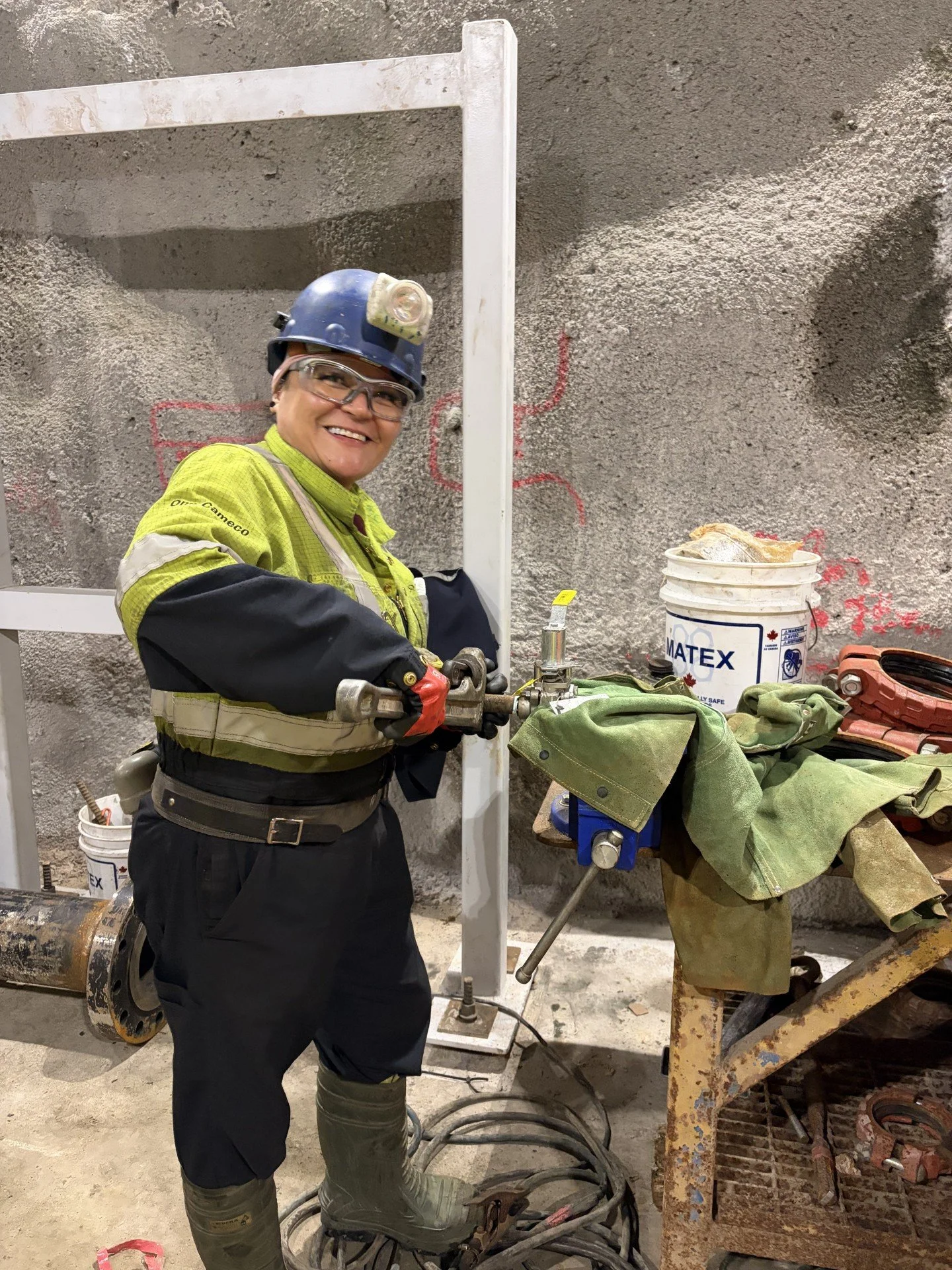
Tracy remembers the moment clearly. She was in a ditch, shovel in hand, working as a laborer on one of her first jobs, and a single thought kept running through her head.
“I was just shoveling away, and I said, ‘I don’t want to shovel all my life,’” she says. “So that’s why I am where I am.”
Today, Tracy is heading into the fourth and final year of her pipefitting apprenticeship with Flatstone Construction, working underground at a uranium mine in northern Saskatchewan. She’s a proud member of English River First Nation, one of very few women in her trade, and a living example of what’s possible for young people across the North.
GROWING UP WITH THE GUYS
Tracy’s path into the trades started long before she ever picked up a wrench on a job site. Growing up, she was, in her words, “kind of a tomboy.” She spent her time with her brothers and cousins, hanging out in the shack and working on projects alongside them.
“They taught me a lot growing up,” she says. “If it wasn’t for them, I don’t think I’d be where I am today.” She’s quick to name them: her cousin Richard Gardiner and her brother Jason Aubichon. “I always tell that to him.”
FINDING HER TRADE
When Tracy told her leadership she wanted more than laboring work, they gave her a chance to find out what fit. She tried electrical, carpentry, and pipefitting, rotating through each trade shift by shift.
“I really stuck with pipe fitting,” she says. “I really like it, actually.”
It’s an approach she believes in for anyone starting out. People don’t always know where they belong until they try. “If they don’t try it, then they won’t know, right?” Along the way, Tracy also completed her first and second year of welding, and her instructors kept encouraging her to keep going with it. Once she earns her pipefitting ticket, her next goal is to become dual-ticketed as a welder, giving her the flexibility to either fit or weld on the job.
PROVING THEM WRONG, ONE PIPE AT A TIME
Being a woman in a male-dominated field hasn’t always been easy. The hardest part, Tracy says, is being underestimated.
“Some guys would really underestimate you. ‘Oh, you can’t do that,’ or, ‘You can’t lift that.’”
On one project, a coworker told her flatly that a pipe was too heavy for her to carry. Tracy didn’t argue. She simply walked over, picked it up, and brought it where it needed to go. “He’s like, ‘Oh, you got it.’”
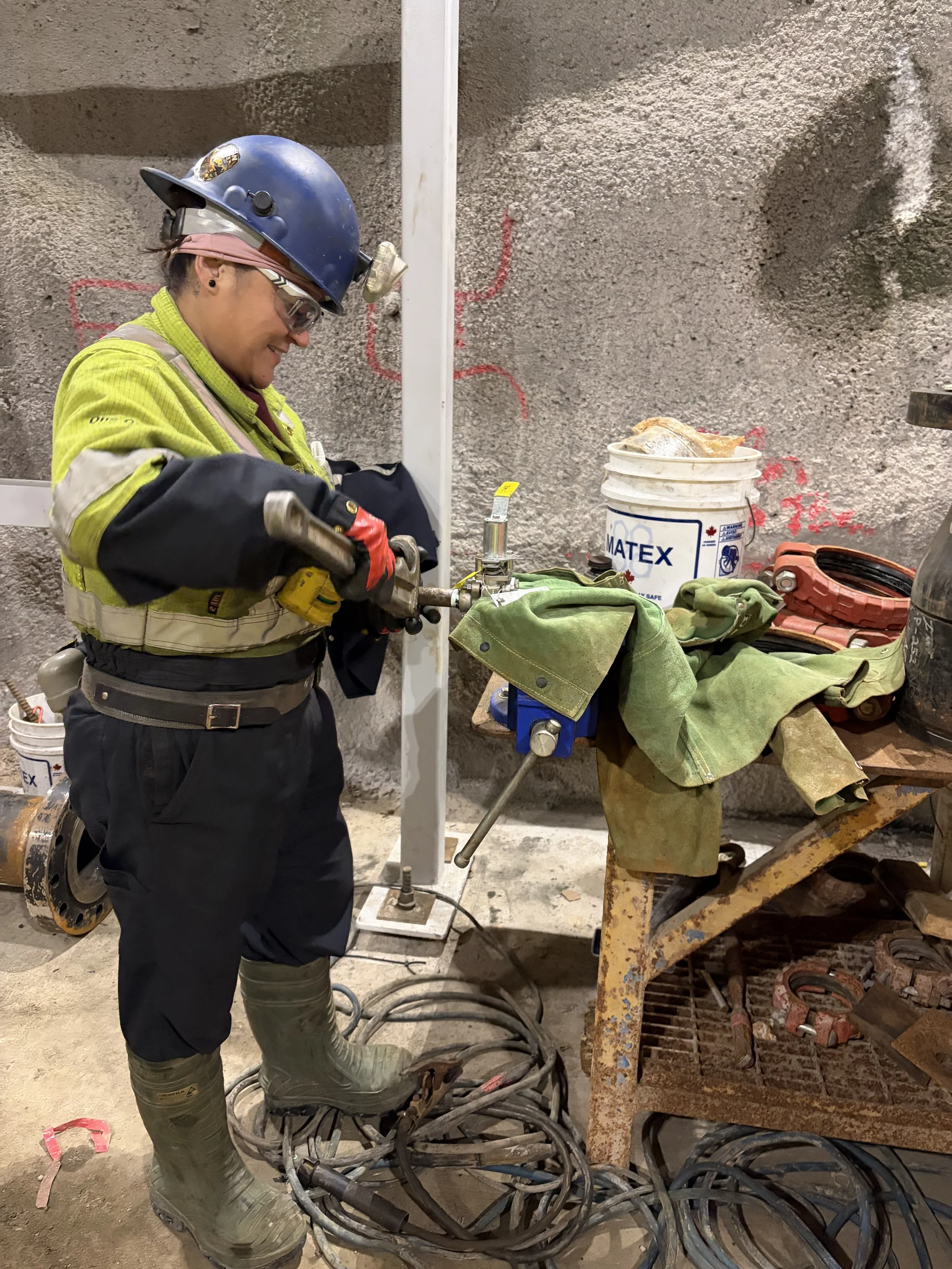
Tracy at work underground at McArthur River, heading into the final year of her pipefitting apprenticeship.
“It’s actually good when people notice, especially for a female out in this field. ”
Her response to offers of help has become something of a personal rule: “Just wait. If I can’t do it, I’ll ask you for help.” And when she does need a hand, she says, her crew is there for her.
The respect has followed. Coworkers consistently describe her as a great worker and an awesome person, “one of the team.” Underground at Cigar Lake, where she was often the only woman in the area, a man she didn’t even know tapped her on the shoulder one day.
“He said, ‘You’re doing a good job out there. Keep it up. I see all the guys standing around. You’re the only one that’s just busy working,’” Tracy recalls. “It’s actually good when people notice, especially for a female out in this field.”
THE HARDEST PART
Rotational work in the mines means early mornings, long shifts, and cage rides underground into damp, dark conditions where, in the winter, you rarely see daylight. But for Tracy, the toughest part of the job has nothing to do with the work itself.
“The hardest thing is leaving my girl.”
She credits her mom, her sister, and her cousin Shaniya Black for caring for her daughter while she worked and went to school. “They helped out a lot.”
Her daughter, now 20, is in her second year of culinary school while holding down a part-time job, and she’s noticed the resemblance. “She’s like, ‘I’m like my mom,’” Tracy says with a smile. “You got a lot of jobs. You’re always busy.”
ADVICE FOR THE NEXT GENERATION
Asked what she would tell a young woman from English River who is trying to find her path, Tracy doesn’t hesitate.
“Know your worth, trust your
skills, and just keep pushing
forward, and you’ll get where
you want to be.”
“IF YOU’RE NOT GOING TO DO IT, NOBODY WILL DO IT FOR YOU BUT YOU”
It’s advice rooted in something her grandpa always told her: “If you’re not going to do it, nobody will do it for you but you.”
She also has a practical message for employers who want to support more women in the trades: make sure the gear fits. Gloves that are too big to grip with and harnesses designed for men’s bodies are everyday obstacles for tradeswomen. “I’ve seen those ladies’ harnesses out there,” she says. It’s a small change that makes a real difference in both comfort and safety.
RIGHT WHERE SHE WANTS TO BE
With her ticket in sight, Tracy is happy where she is. She likes working underground (“It’s away from the elements, the sand flies”), she likes her crew, and she isn’t in a hurry to move into supervision.
“I’m good as a worker. I like working. It keeps me busy.”
For young people in Patuanak and across the North who don’t yet know what they want to do, Tracy’s story is proof that the path can start anywhere, even at the bottom of a ditch with a shovel, as long as you’re willing to keep pushing forward.